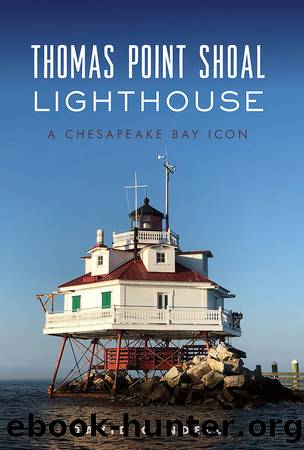
Thomas Point Shoal Lighthouse by David Gendell
Author:David Gendell
Language: eng
Format: epub
Publisher: The History Press
Published: 2020-10-14T16:00:00+00:00
THE ICE EMERGENCY
With demand for oysters at historic highs, more than a thousand schooners and pungies set out to be part of the 1876â77 Chesapeake Bay oyster season. Baltimoreâs streets were paved with oyster shells, and its oyster canning industry employed thousands. New Yorkâs Fulton Fish Market could sell about fifty thousand oysters each day, many of which were delivered daily directly from Baltimore aboard trains. Oystermen were a rugged lot and diligently took to the Bay even when challenged by extended periods of winter weather. In early December 1876, a âpolar hurricaneâ led to the stranding of five oyster schooners in the Chester River. According to the Baltimore Sun, âa number of lives were lost.â The Sun continued, âThe tale of suffering from freezing, starvation, and other privations would fill a volume.â But those who could harvest oysters and safely return to port stood to make a handsome profit.
Several stretches of cold weather in early January 1877 froze the Bay solid and prevented most oystermen from leaving shore. With supply pinched, the price of oysters soared, ensuring a fat profit for those who were able to harvest any amount of oysters and get them back to shore. Many of those who ventured out into the cold waters were trapped when the Bay froze solid. Despite continuous efforts of boats repurposed for icebreaking duties, the Port of Baltimore had to impose an ice embargo on December 10âno major ship traffic could move in or out of the port.
On January 8, the approach to the harbor was finally clear enough for the embargo to be lifted. But the freezing temperatures soon returned, even colder than before, and the embargo was reinstated after just one open day. Among those stuck at Baltimore were the crew of Lake Megantic, a massive steamship with sixty-two thousand bushels of corn and fifty-five tons of oil cake in its holds, aiming for England but held prisoners by the Chesapeake ice.
At Annapolis, where the passage from the open Bay to a relatively safe anchorage stayed open longer and more consistently than in Baltimore, three hundred to five hundred vessels were trapped by the ice, unable to move on the Bay and on to Baltimore. Barques, brigs, schooners and pungies anchored en masse across the mouth of the Severn River, among them Madcap, a Baltimore-bound barque loaded with coffee, prevented by the ice from completing its passage. The majority of the ships were foreign, including vessels from Italy, Norway, Austria, Russia and England. Five large steamships waited at Annapolis for permission to move to Baltimore. The Baltimore Sun reported, âFrom Greenbury Point to Annapolis, a distance of three miles, the vessels were so thickly strung that one could walk from deck to deck to the city. On entering the harbor from the Bay the dense forest of masts almost obscured the ancient city from view.â The Maryland Republican newspaper of Annapolis reported:
When it was impossible for the hundreds of tugboats, steamers, ice boats, and other boats to keep
Download
This site does not store any files on its server. We only index and link to content provided by other sites. Please contact the content providers to delete copyright contents if any and email us, we'll remove relevant links or contents immediately.
Kathy Andrews Collection by Kathy Andrews(11772)
The remains of the day by Kazuo Ishiguro(8906)
Spare by Prince Harry The Duke of Sussex(5150)
Paper Towns by Green John(5149)
The Body: A Guide for Occupants by Bill Bryson(5044)
Industrial Automation from Scratch: A hands-on guide to using sensors, actuators, PLCs, HMIs, and SCADA to automate industrial processes by Olushola Akande(5028)
Machine Learning at Scale with H2O by Gregory Keys | David Whiting(4268)
Be in a Treehouse by Pete Nelson(4005)
Never by Ken Follett(3893)
Harry Potter and the Goblet Of Fire by J.K. Rowling(3818)
Goodbye Paradise(3778)
The Remains of the Day by Kazuo Ishiguro(3359)
Into Thin Air by Jon Krakauer(3355)
Fairy Tale by Stephen King(3316)
The Cellar by Natasha Preston(3301)
The Genius of Japanese Carpentry by Azby Brown(3265)
120 Days of Sodom by Marquis de Sade(3235)
The Man Who Died Twice by Richard Osman(3047)
Drawing Shortcuts: Developing Quick Drawing Skills Using Today's Technology by Leggitt Jim(3045)
